Pablo Picasso – Die Freiheit der späten Werke
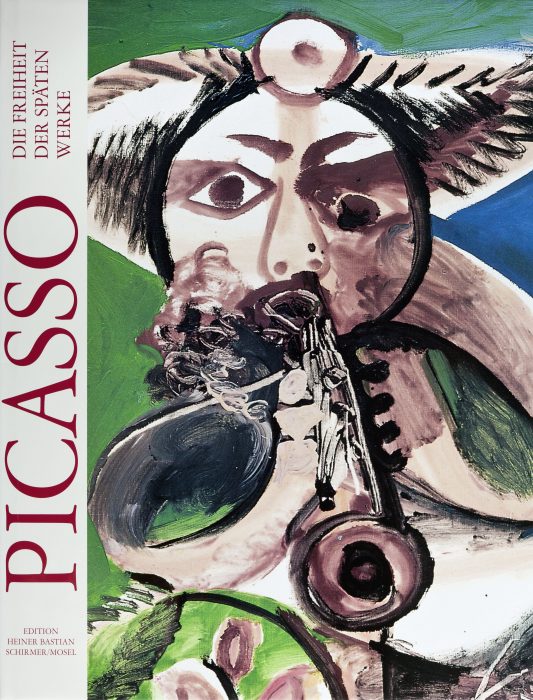
Published by Heiner Bastian
With texts by Aeneas Bastian und Heiner Bastian
80 pages, 38 colour plates
Size: 30.5 x 23.5 cm, hardcover
Schirmer/Mosel Verlag, Munich, 2011
English/German edition
39 € (plus postage fees)
The freedom that defines Picasso’s late work remained, for many years, a discovery reserved almost exclusively for the artist himself, which he could share with only a select few. When the paintings of his final years first were exhibited in 1970 and 1973 at the Palais des Papes in Avignon, the public responded with hesitation, rejection, yes even ignorance. These works were condemned, assailed, and denounced as a betrayal of the very analytical, prismatic consciousness of form that had established Picasso as the twentieth century’s preeminent artist—his grand glass bead game. Critics believed these paintings marked the abandonment of the once sublimely reflective language of images. The untamed upheaval of the works, the venture of this painting, was mistaken for a mirror in which not life itself, but the psychological mechanisms of life appeared in pictorial form: redundant endgames, images at the edge of the approaching night.
These late works are dominated by the relativity of motif invention, by the continuation, indeed the destruction of a definitive solution. Defiance, upheaval—Picasso’s amalgam of terror, beauty, and provocation: Within this shock, the artist implicates himself visible in the mirror of time as it flows away from him. Only a few recognized in these paintings something genuinely new: Baudelaire’s path, the attempt to »arrive at the unknown«. They had forgotten that the artist is always the destroyer of his own world of forms; that Picasso had never been concerned with style as an end in itself, but with new pictorial language, the accent of what was yet to come.
The newness,the still unrecognized freedom of Picasso’s late work, became the driving force of elemental conflicts – the destruction and reconstruction of roles, masks, and identity. And hasdeparture not always been the defining constant of Picasso’s own »art history«? It is metamorphosis, revelation, and the crossing of boundaries, the rites of destruction through ever-renewed discoveries, that determine the progress of the late work.
Picasso was the artist who crossed the twentieth century like a comet. He did not need style. He could travel mile upon mile sustained by the force of his own assertions, he was his own auto-da-fé.
Heiner Bastian
"*" indicates required fields